Post the title and short description of your favorite work from the museum exhibit.
For those of you that weren't able to go, find a a work online and add a full description along with the title.
Monday, February 25, 2013

Art One - High Museum trip
Post the title and short description of your favorite work from the museum exhibit.
For those of you that weren't able to go, find a a work online and add a full description along with the title.
For those of you that weren't able to go, find a a work online and add a full description along with the title.
Ceramics - High Museum
Post the title and short description of your favorite work from the museum exhibit.
For those of you that weren't able to go, find a a work online and add a full description along with the title.
For those of you that weren't able to go, find a a work online and add a full description along with the title.
Wednesday, February 20, 2013
Ceramics - Tour Casa Azul
Opening: A virtual tour of Casa
Azul (URL: http://www.recorridosvirtuales.com/frida_kahlo/museo_frida_kahlo.html)
Tour the Casa Azul and tell me what you think. Click on all of the green dots to tour each room.
Art One - Tour Casa Azul
Opening: A virtual tour of Casa
Azul (URL: http://www.recorridosvirtuales.com/frida_kahlo/museo_frida_kahlo.html)
Visit the tour and tell me what you think. Click on all of the green dots to tour each room.
Tuesday, February 12, 2013
All Art students
Don't forget to comment on your blog by FRIDAY.
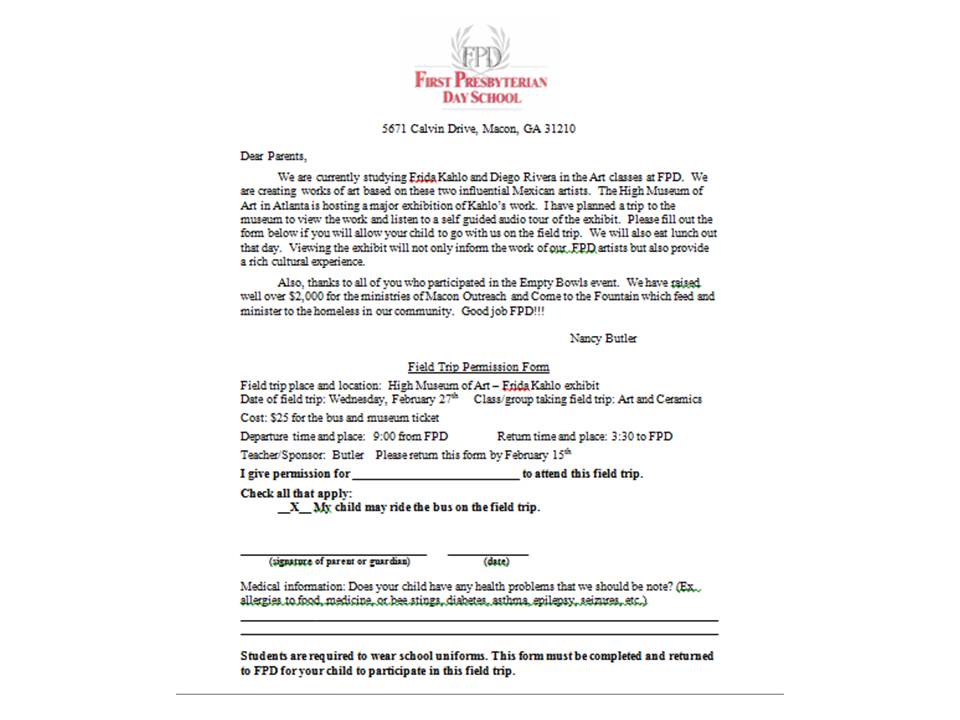
Remember also to get your permission slip signed and returned by FRIDAY.
If you forgot yours, you can click on the form below, copy it and paste to a Word document to print at home.
I still need more chaperones too!

Remember also to get your permission slip signed and returned by FRIDAY.
If you forgot yours, you can click on the form below, copy it and paste to a Word document to print at home.
I still need more chaperones too!
Monday, February 11, 2013
Art One - Casa Azul

Diego Rivera and Frida Kahlo’s House-Studio is one of the most important cultural landmarks in Mexico City, for being the place of residence and work of two of the most important artists in the 20th Century, Diego Rivera and Frida Kahlo, as well as for being the first construction of the modern movement built in the American continent.
This construction, built in 1931 by the architect Juan O’Gorman, represented the breaking of every aesthetic paradigm in Mexican architecture up to that time, strongly incorporating the most forward theories and thoughts which architects like Le Corbusier were developing simultaneously in Europe. Thoughts like the rational use of materials, the analysis of each space’s function and the adjustment of each space to the activities that took place within it; ideas that were radical in the beginning but that, with time, were taken in by architecture all around the world.
This building was designed and constructed based upon the 5 points proposed by Le Corbusier: structure supported by pilotis, open floor plan, free façade, roof garden (to compensate the green area consumed by the building) and long strips of windows; but it’s also a Mexican house with strong colours, textured floors and a cactus fence. It’s an honest house that shows us its steel skeleton, its pipes, its staircases, its economic materials; it’s a house that could be in any town, not afraid of letting us know it’s a factory, a machine for living, an art machine in which Diego and Frida produced an aesthetic world nurtured by Mexico, its history, its people, its problems and its biggest dreams.
This interesting space is composed by two blocks or main houses, a red one that represents Diego Rivera and a blue one, Frida Kahlo, both joined by a bridge, a bond of passion between them. Within them we can see their bedrooms, their workshops and other spaces that have been visited by characters like André Bretón, María Félix, Pablo Neruda, Dolores Del Río, Nelson Rockefeller and Lázaro Cárdenas, among others.
Since 1986 this House-Studio has been open to the public, showing how these two artists used to live and work. It’s a must-see place for art and architecture lovers who are visiting the city.
Ceramics - Kahlo/Rivera House - Casa Azul
Diego Rivera and Frida Kahlo’s House-Studio is one of the most
important cultural landmarks in Mexico City, for being the place of residence
and work of two of the most important artists in the 20th
Century, Diego Rivera and Frida Kahlo, as well as for being the first
construction of the modern movement built in the American continent.
This construction, built in 1931 by the architect Juan O’Gorman,
represented the breaking of every aesthetic paradigm in Mexican architecture up
to that time, strongly incorporating the most forward theories and thoughts
which architects like Le Corbusier were developing simultaneously in Europe.
Thoughts like the rational use of materials, the analysis of each space’s
function and the adjustment of each space to the activities that took place
within it; ideas that were radical in the beginning but that, with time, were
taken in by architecture all around the world.
This building was designed and constructed based upon the 5 points
proposed by Le Corbusier: structure supported by pilotis, open floor
plan, free façade, roof garden (to compensate the green area consumed by the
building) and long strips of windows; but it’s also a Mexican house with strong
colours, textured floors and a cactus fence. It’s an honest house that shows
us its steel skeleton, its pipes, its staircases, its economic materials; it’s a
house that could be in any town, not afraid of letting us know it’s a factory, a
machine for living, an art machine in which Diego and Frida produced an
aesthetic world nurtured by Mexico, its history, its people, its problems and
its biggest dreams.
This interesting space is composed by two blocks or main houses, a
red one that represents Diego Rivera and a blue one, Frida Kahlo, both joined by
a bridge, a bond of passion between them. Within them we can see their bedrooms,
their workshops and other spaces that have been visited by characters like André
Bretón, María Félix, Pablo Neruda, Dolores Del Río, Nelson Rockefeller and
Lázaro Cárdenas, among others.
Since 1986 this House-Studio has been open to the public, showing how
these two artists used to live and work. It’s a must-see place for art and
architecture lovers who are visiting the city.
Tuesday, February 5, 2013
Ceramics - Rivera
Follow the link to view a gallery of paintings by Diego Rivera. Click on the first one and then scroll through all of them. There are about 45. Choose your favorite and tell us why.
http://www.diego-rivera.com/diego-rivera-paintings.jsp
http://www.diego-rivera.com/diego-rivera-paintings.jsp
Art One - Rivera
Follow the link to view a gallery of paintings by Diego Rivera. Click on the first one and then scroll through all of them. There are about 45. Choose your favorite and tell us why.
http://www.diego-rivera.com/diego-rivera-paintings.jsp
http://www.diego-rivera.com/diego-rivera-paintings.jsp
Tuesday, January 29, 2013


Monday, January 28, 2013
Art One - Color Theory survey

Follow the link below and complete the survey. You don't have to put in your email address if you don't want.
Which question and color comparison was the most interesting?
http://www.colormatters.com/color-symbolism/global-color-survey
Wednesday, January 23, 2013
Ceramics - Masks from Around the World

Watch the following video. It's about 6 minutes long.
Which one is your favorite and why? What country is it from?

Wednesday, January 16, 2013
Ceramics - Empty Bowls Project
Below is from the Empty Bowls website to further explain the project.
Why should FPD participate?
Empty Bowls is an international grassroots effort to fight hunger and was created by The Imagine Render Group. The basic premise is simple: Potters and other craftspeople, educators and others work with the community to create handcrafted bowls. Guests are invited to a simple meal of soup and bread. In exchange for a cash donation, guests are asked to keep a bowl as a reminder of all the empty bowls in the world. The money raised is donated to an organization working to end hunger and food insecurity.
It is the collective genius of all the people involved that has made Empty Bowls what it has become. Events have now taken place across the United States
Each individual or group organizing an event designs it around the needs of their own community and is responsible for their own event. We ask that all such events are called Empty Bowls so that the idea can continue to spread. Please make your event inclusive, insist that it maintain a high level of integrity, include an educational component to raise awareness, and give the money raised to an organization helping to feed people in need.
The largest hunger-relief organization in the United States
Please find the time, make the commitment, get involved. Your single effort can have a profound impact.
“Volunteering is the ultimate exercise in democracy. You vote in elections once a year but when you volunteer, you vote everyday about the kind of community you want to live in.”
-Marjorie Moore
Art One - Blog 3 - Mandala
Tibetan monks create a mandala (sand painting) as a ritual. Watch this short video. What do you think about the image and the symbolism?
http://www.youtube.com/watch?v=9QItAyepAnI
http://www.youtube.com/watch?v=9QItAyepAnI
Tuesday, January 15, 2013
All Art and Ceramics Students - letter
I need your signed letters by tomorrow! It will pain my heart to give you a "0" but...... I will. I would much rather give you a 100!!!
Tuesday, December 11, 2012
All Art Students
All late blog comments are due by Friday, December 14. I will check these during mid terms and will add or adjust the grades accordingly. Late posts will receive half credit and I will drop the lowest one.

Art One & Art Two - Cezanne
 |
| Paul Cézanne; 1839–1906) was a French artist and Post-Impressionist painter whose work laid the foundations of the transition from the 19th-century conception of artistic endeavour to a new and radically different world of art in the 20th century. Cézanne can be said to form the bridge between late 19th-century Impressionism and the early 20th century's new line of artistic enquiry, Cubism. The line attributed to both Matisse and Picasso that Cézanne "is the father of us all" cannot be easily dismissed. Cézanne's often repetitive, exploratory brushstrokes are highly characteristic and clearly recognizable. He used planes of colour and small brushstrokes that build up to form complex fields. The paintings convey Cézanne's intense study of his subjects. |
Subscribe to:
Comments (Atom)